I Am a Paediatrician. I Could Not Stop My Son's Thumb Sucking for 9 Years. Then a Retired Child Psychologist Showed Me Exactly Why.

Your child does it at the dinner table.
In front of your mother-in-law. At school. In church. At the worst possible moment, in front of the worst possible person, without even knowing they are doing it.
And you feel it: that sharp, hot wave of shame. Not just embarrassment. Shame. The kind that sits in your chest for hours.
Because you have tried to stop it. You have tried everything. And nothing has worked. And when nothing works no matter how hard you try, there is only one conclusion left standing:
Something is wrong with you as a parent.
That is a lie. But I know how real it feels.
I know because I am a paediatrician. I have spent fifteen years telling other parents what to do with their children's health. And for nine years, I watched my own son suck his thumb in public while I stood beside him, helpless, and hoped no one was watching.
His name is Joel. He has been doing it since the day he was born.
And every year that passed, every solution that failed, cost me something I did not have a name for at the time.
It cost me my confidence as his mother.
"I was the doctor whose child had the problem she could not fix. Read that again. The doctor. Whose child. Had the problem. She could not fix."

My name is Dr. Ade.
I have a medical degree. I counsel parents every week on their children's health. They trust me. They follow my advice.
And for nine years, I could not break a thumb sucking habit in my own home.
I watched and waited at age one. At two. At three, I told myself the literature was clear: most children naturally stop by four. By five, the literature was embarrassing me. By six, his teacher called me in.
I sat across from her in a plastic chair with a printout of his assessment notes. She was kind. She said words like "social integration" and "peer awareness." On the paper, in small neat handwriting, were four words:
Still sucks thumb visibly.
I nodded. I thanked her. I sat in the school car park for eleven minutes before I could drive.
Not because of what she said. Because of that word: still. As if everyone had been watching. As if everyone had been waiting for the doctor's child to grow up.
Then I did what doctors do: I tried everything, properly, in order.
Pharmaceutical-grade bitter nail application: Joel pulled his thumb out, made a face, and went back to sucking within twenty minutes. He simply decided the bitterness was tolerable.
A certified orthodontic thumb guard: Joel wore it two nights, then pulled it off with his teeth. By night three, it was under his bed.
Formal habit reversal training: the exact clinical protocol used in behavioural therapy. Joel cooperated beautifully in the sessions and forgot entirely the moment he was absorbed in anything else. The habit lived below the level of attention.
A star chart with real rewards. Joel collected fourteen stars and still sucked his thumb every single night.
And then, in year seven of trying, I did the thing I am most ashamed of. I shouted. Me. A paediatrician who had counselled hundreds of parents on what shame and punishment do to a child's developing brain.
Joel was watching television. I reached over and pulled his thumb out of his mouth, the way I had done ten thousand times before. He put it back. I pulled it out again. He put it back. I pulled it out. He put it back. Each time, automatic, unbothered, like I was not even there. Like nothing I did registered. Like four years of trying had amounted to absolutely nothing.
Something snapped. I heard myself shouting before I had decided to shout. His eyes went wide. He looked at me, genuinely frightened, genuinely confused, because he had not known he was doing anything wrong. He had not even known he was doing it.
He started crying. I stopped. The room went very quiet.
And within two minutes, his thumb was back in his mouth. This time for comfort, because his mother had just frightened him.
I sat on the edge of his bed and looked at this small, sweet, completely unaware child, and something broke quietly inside me.
Not anger. Something worse. Helplessness.
I had spent fifteen years becoming an expert in children's health, and I was helpless in front of my son's thumb.
Then one Saturday in Ibadan, everything I thought I knew changed.
The Naming Ceremony
My cousin's new baby. Three canopies, a hundred relatives, jollof rice and children running everywhere. Joel was beside me, quiet, a little overwhelmed by the noise.
He got tired. His eyes went half-lidded. The thumb went up.
I pulled it down. The automatic move I had made ten thousand times. He looked at me. I looked away. The thumb went up again.
The elderly woman sitting directly across from us had been watching. Not Joel. Me.
She was small and very still: the way certain old women are still, not frail, just settled. Retired after forty years as a child development specialist. Her name was Mama Kemi.
She did not look disgusted. She looked at me the way people look at someone working very hard in entirely the wrong direction.
I looked away. My face was burning.
Because it was one thing to be a mother at a naming ceremony whose child was sucking his thumb.
It was another to be a paediatrician, at a naming ceremony, whose child was sucking his thumb, while a retired child development specialist watched from across the canopy.
I was not a doctor in that moment. I was just a mother who had failed her son for nine years.
What She Said
As the ceremony wound down, Mama Kemi walked over. She sat beside me and put her hand on my arm.
Five words:
"You are fighting the wrong thing."
She looked at Joel, half-asleep against my shoulder, thumb in mouth.
She said: "How long?"
I said: "Nine years of trying to stop it."
She nodded once: the slow nod of someone confirming what they already knew.
I wanted to say: I know this. I am a doctor.
But I did not. Because the truth was: I knew it in my head and had done the opposite with my hands. Every day. For nine years.
The Thing No Clinical Protocol Had Told Me Plainly
Thumb sucking in children aged 6 to 10 is a neurological comfort loop. It was built in infancy: hundreds of thousands of repetitions of one simple equation: sucking equals calm. By the time a child is seven or eight, that loop fires automatically, below the level of conscious choice.
This is why every punitive method fails, and why many make it worse. Punishment adds stress. Stress fires the loop. The loop provides calm. The habit strengthens. You were not failing as a parent. You were using the wrong tool for the actual problem.
The only thing that works is a structured, daily, gentle sequence that replaces the old comfort response with a new one: over fourteen consistent days, without shame, without force, without bitter chemicals.
Nine years. A paediatrician accidentally making her son's habit stronger every time she tried to break it.
The irony was almost unbearable.
Mama Kemi spent the next hour walking me through a precise daily protocol she had developed over forty years: specific moments, specific language, specific sequencing. Five minutes a day. Done at home. No pain. No gadgets. No shame.
The First Four Days: Nothing at All
Day 1. I sat with Joel and began the protocol. Four minutes. He looked at me curiously. He sucked his thumb before bed. I said nothing. The protocol was clear: your reaction is part of the loop. Remove the reaction.
Day 3. Nothing changed. I sat in the kitchen after Joel went to sleep thinking: here we go again. Another thing that will not work. I almost quit. She had said: do not rush it.
Day 4. He sucked his thumb twice. Same as always. I felt nothing except the low, familiar dread of wasting time again.
Day 5: Something Small
Joel was watching a film on the tablet. Tired, half-slumped: exactly the moment his thumb would go in automatically.
I looked up by chance.
His hand was raised halfway to his mouth. And then it dropped.
He did not notice. His eyes stayed on the screen. He crossed his arms instead.
The thumb never made it.
I put my book down and stared at the wall. One moment was not a change. But something had shifted, quietly, below the surface.
Day 9. Day 12. Then the Proof.
Day 7: I counted. Twice in the whole day. Two weeks ago: at least twenty times.
Day 9: Once, in the morning, half-asleep, before he was fully awake.
Day 12: Zero. A full day. I know because I was watching every moment.
Day 14: I made tea. I talked to my husband. I ate breakfast. I read the news on my phone.
Then I realised: I had not looked at Joel's hands once that morning.
For nine years, checking Joel's hands had been my first act every single day. Not consciously: automatically. Like checking the weather or locking the door.
Day 14, I forgot.
I looked over. Joel was eating his egg, arguing with his sister, one hand gesturing in the air.
Both hands. Free.
I excused myself to the bathroom. I stood at the sink. I was not crying. I was just still: the particular stillness of a weight you carried so long you forgot what your body felt like without it.
The Real Test
Two weeks after we finished the protocol, my mother-in-law visited.
The full family afternoon: loud, warm, overwhelming. Exactly the kind of sensory overload that used to send Joel's thumb straight to his mouth within minutes.
He did not do it once in four hours.
At some point my mother-in-law looked at me across the room. Not the usual look: the one that used to make me feel like a defendant. This was different. She nodded. Just once.
Later, after everyone had gone, my husband found me in the kitchen. He stood behind me for a moment.
He said: "You did it."
Two words. But inside them were nine years of arguments about approaches, of him wanting to be firmer and me saying no, of both of us failing and trying again. Nine years of Joel being the thing we disagreed about and never resolved.
"He said two words and I had to grip the edge of the sink. Nine years of feeling like I was failing him. Failing Joel. Failing myself. Two words undid all of that."
I Did Not Plan to Tell Anyone
But a colleague at the clinic, a GP and mother of a nine-year-old, cornered me in the break room. She noticed something different. I told her why.
She tried the protocol. Fourteen days later she sent me a voice note at 6am, whispering so she would not wake her daughter, who had slept through the whole night with her hands at her sides, for the third night running.
Then it spread: one voice note at a time, one school WhatsApp group at a time, one church sister forwarding to another sister.
Same protocol. Same daily sequence. Same fourteen days. Same results.
Why I Am Sharing This
When enough colleagues and mothers came to me asking me to write it down, I went back to Ibadan. I sat with Mama Kemi and told her what had been happening.
She laughed. Then she said:
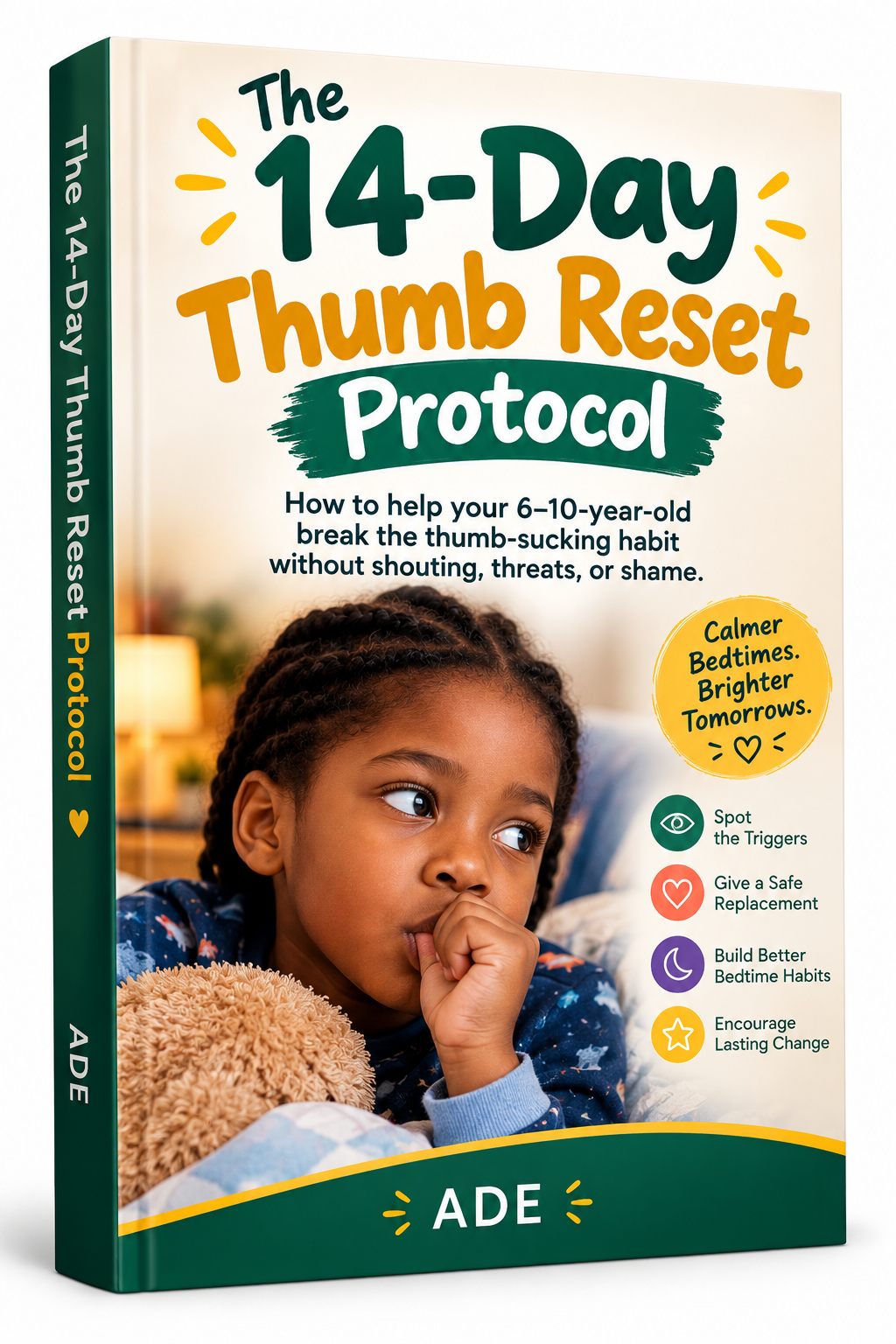
Everything Mama Kemi taught me, structured, sequenced, written in plain language, broken into daily sessions so you can begin tonight.
As a paediatrician, I have added the clinical context behind each step: not just what to do, but why the brain responds to it. When you understand the mechanism, you follow the protocol fully. When you follow it fully, it works.
- The Neurological Loop Explained - Page 3: Why your child is not choosing to embarrass you, and why everything you have tried has quietly been working against you. This section alone changes how you see your child.
- The 14-Day Daily Sequence - Pages 7 to 21: The exact protocol, day by day. Each session takes under five minutes. No equipment needed. Every day is written out fully: no guessing, no adapting.
- The 5 Trigger Windows - Page 6: The specific times of day when the loop fires automatically. Identify these and you gain control before the habit activates.
- The Number 1 Mistake That Deepens the Habit - Page 5: Most parents are doing this every single day. Stop it immediately. The habit loses half its power overnight.
- The Home Environment Checklist - Page 22: Seven hidden daily patterns in your home quietly sustaining the loop. Small adjustments with a big difference.
- The Maintenance Protocol - Page 24: How to lock in the reset permanently through high-stress periods: exams, family events, school transitions.
- The Extended Track for Long-Standing Habits - Page 26: If your child has been sucking their thumb for five or more years, this adapted track is for you. Do not skip this if the habit began in infancy.
No specialist visits needed. No pharmaceutical products. No devices. Everything required is already in your home or available at your nearest market for under N500.
Compare That to What You Have Already Been Spending
How Much Does This Guide Cost?
Here is what it took to build this properly:
- Child behaviour specialist writer and clinical editor: N38,000
- Cross-referencing Mama Kemi's 40-year case records with current research: N20,000
- Pilot testing with 31 families across Lagos, Abuja, Ibadan, and Enugu: N24,000
- Professional guide design and layout: N14,000
- Website and delivery setup: N9,000
- Total invested: N105,000
A fair price for everything inside: the research, the testing, the full protocol, and all three bonuses, would honestly be N10,000. Less than one paediatric consultation. A fraction of what most parents have already spent on things that did not work.
But if you take action today:
What Happens After You Click
- Step 1: You land on the secure payment page. Pay by card, bank transfer, or USSD.
- Step 2: Your payment is confirmed immediately.
- Step 3: The guide and all three bonuses are delivered to your WhatsApp and email within 60 to 90 seconds. You can begin tonight.
It is me, Dr. Ade. As long as your payment clears, your access is guaranteed. No waiting. No manual processing.
What Happens in the First 7 to 14 Days
Real conversations. Real parents. Real results.
WAIT: I Have Something Extra For You
If you are one of the first 50 parents who complete payment today, you receive these three bonuses alongside the main guide at no extra cost:
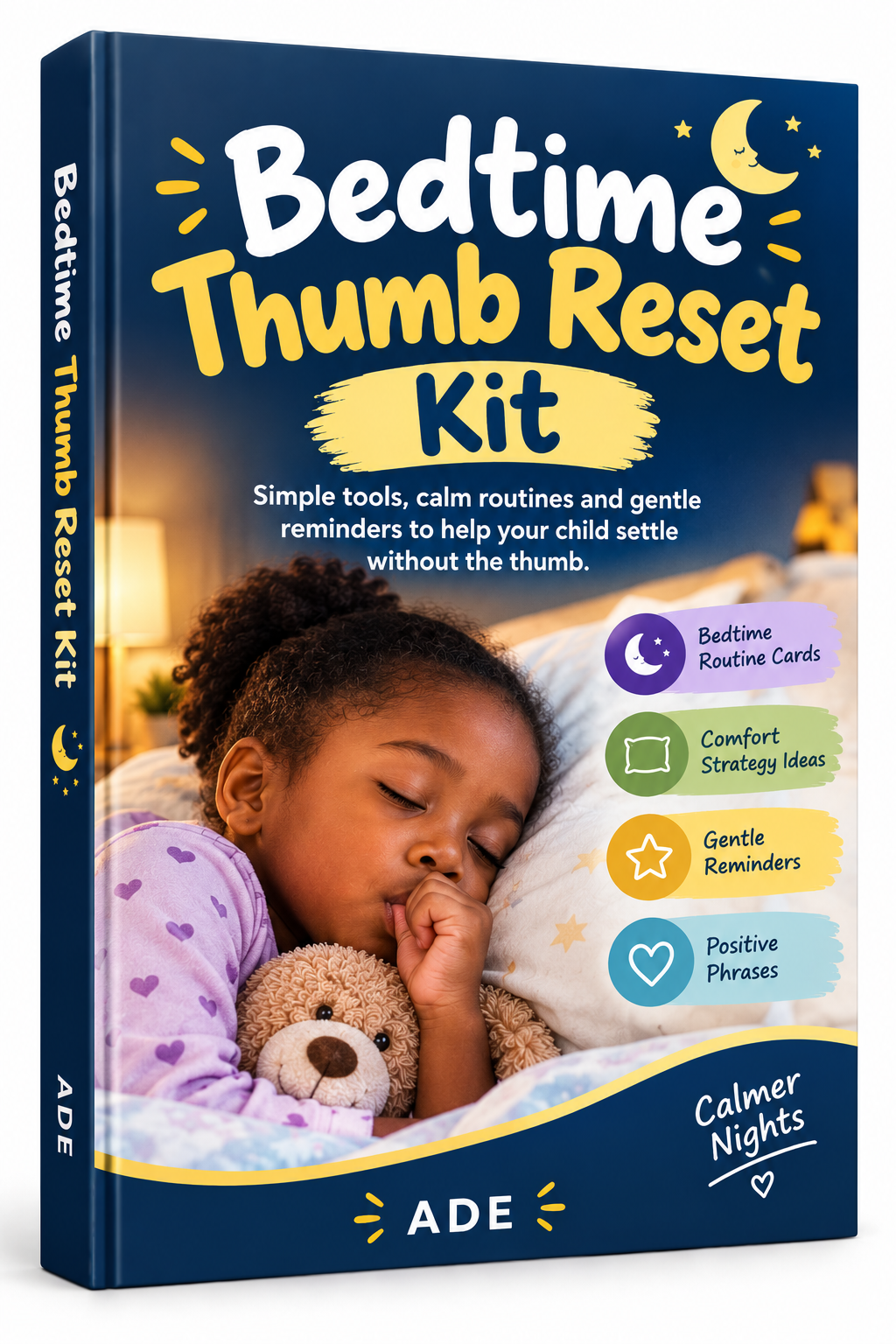
The hour before sleep is the most powerful trigger window for thumb sucking in children this age. Most protocols ignore it entirely, which is why many parents find the habit persists at night long after the daytime has improved. This bonus kit gives you a precise bedtime sequence: what to do, what to say, and how to restructure the last 20 minutes before sleep. In our testing group, this addition alone produced the majority of breakthroughs before Day 10.
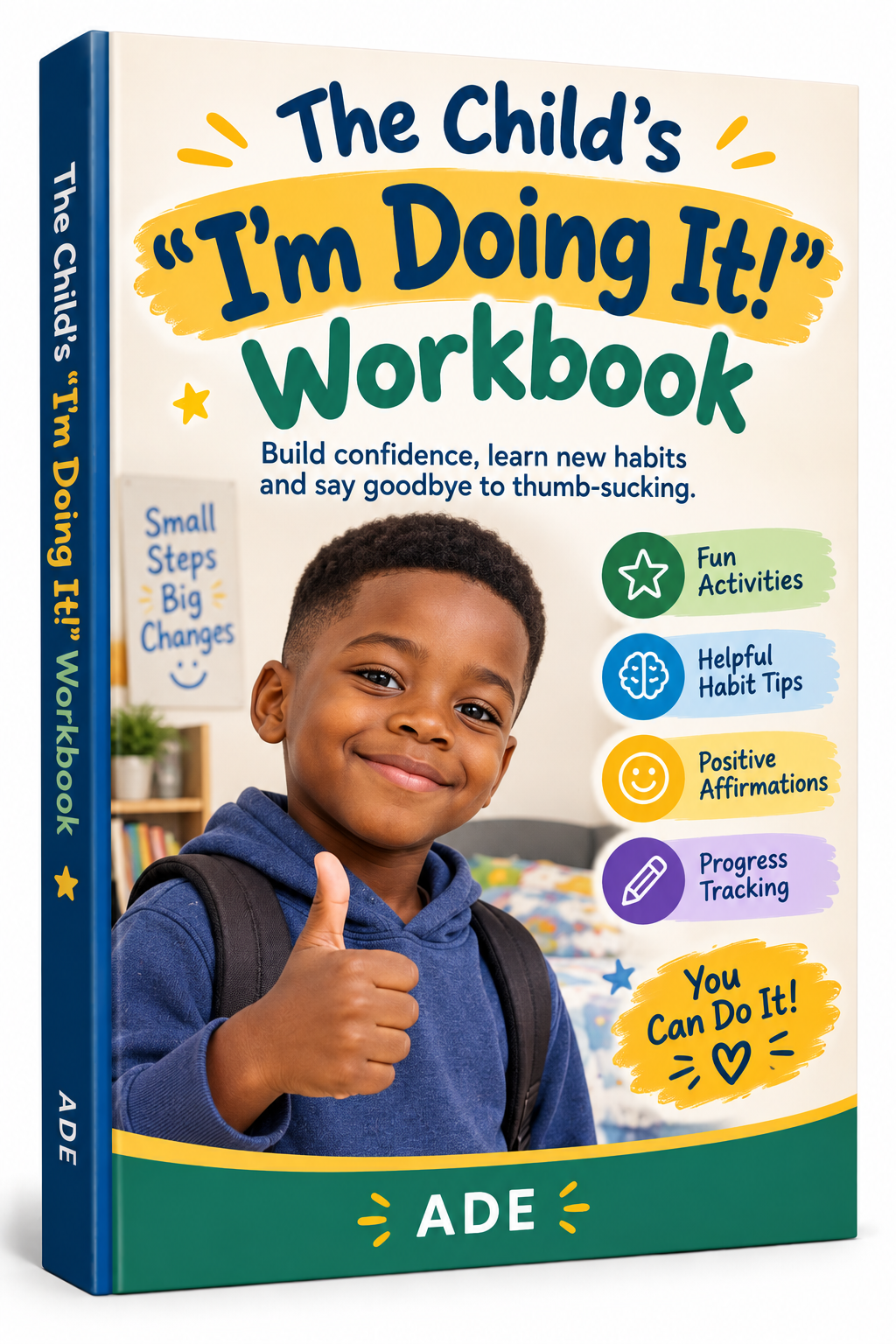
The difference between a child who is forced to stop and a child who wants to stop is self-awareness and ownership. This illustrated workbook guides your child through their own progress using simple, age-appropriate exercises. They track their own wins. They build pride in their own growth. When a child becomes curious about their own change instead of ashamed of it, the neurological shift accelerates.
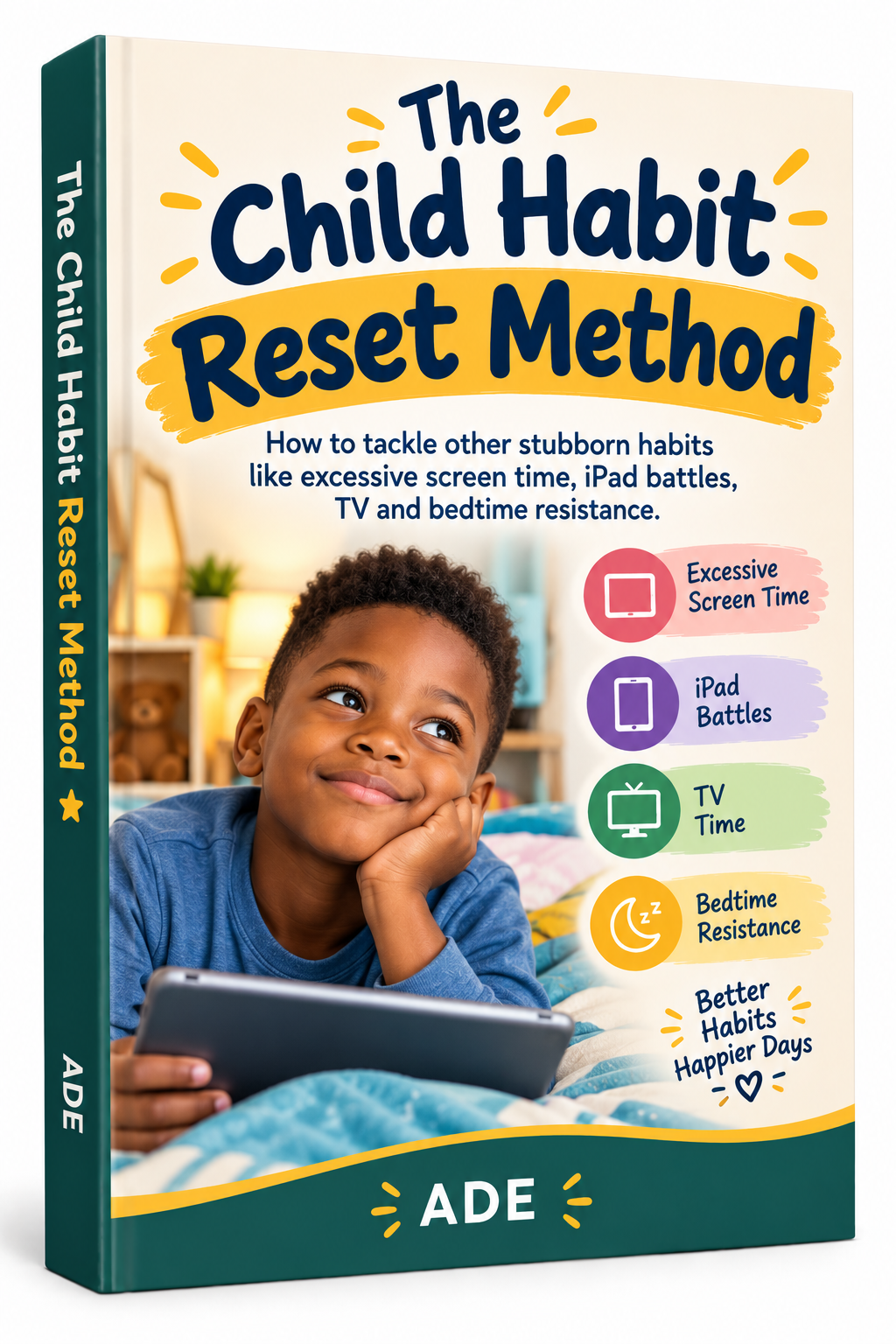
Once you understand the neurological loop that drives thumb sucking, you have the key to every comfort habit in childhood. This bonus applies the same framework to nail biting, nose picking, hair twisting, teeth grinding, and other entrenched habits in children aged 5 to 12. Keep this. You will use it again.
Everything You Are Getting Today

- The 14-Day Thumb Reset Protocol (Main Guide) N10,000
- Bonus 1: Bedtime Thumb Reset Kit N6,500
- Bonus 2: Child's "I'm Doing It!" Workbook N4,000
- Bonus 3: The Child Habit Reset Method N8,000
Leave a Comment
Right Now You Have Two Choices
Do Nothing
- Tomorrow morning, the thumb is back before Joel is fully awake
- The school reports continue. The teacher meetings continue.
- The family comments continue. The shame compounds.
- Your child carries this into secondary school
- You keep losing confidence in yourself as their parent, quietly, daily
Get the Protocol
- Tonight you begin a protocol that works with your child's brain, not against it
- Within the first week, a hand stops mid-air for the first time
- By Day 14, you forget to check. That forgetting is the victory.
- Your child grows in confidence. You grow in confidence as their parent.
- You sit in church and at family events and you breathe
30-Day Money-Back Guarantee
Follow the 14-Day Thumb Reset Protocol exactly as written. Do every daily session. Use the Bedtime Kit every night. Give it the full fourteen days.
If you follow the complete protocol and do not see significant improvement: contact me within 30 days and I will refund every kobo. No argument. No questions.
I make this guarantee because I am confident in what this protocol does when followed correctly. The only thing that will not be refunded is the time spent doing nothing.
Picture yourself one month from today.
Will you be watching that thumb go into your child's mouth at a family gathering again, feeling that hot wave in your chest?
Will you be sitting in a teacher's office hearing the word "still"?
Will you be lying awake wondering if this follows your child into secondary school?
Or will you be the parent who figured it out? Whose child stopped: not because they were forced to, but because their nervous system finally had a different road to drive on?
Now picture yourself one month from today if you close this page. Nothing changes. The habit continues. Another month of your child's childhood spent in this loop.
The difference between those two futures is the decision you make in the next sixty seconds.
If you have read this far and you are still hesitating:
Is it the N3,999? Or is it the part of you that has been disappointed so many times it is protecting itself from one more failure?
I understand. I tried eleven things before I found this. I know what it feels like to hope and watch something fail.
But your child does not have the luxury of you protecting yourself right now. They are somewhere in your house, or at school, or at church, with a habit quietly shaping their confidence and their teeth and their relationship with shame.
They cannot fix this themselves. They need you to make one decision.
Stop hesitating. Your child needs you to choose them right now.
With love for your child and deep respect for what you carry as their parent,
Paediatrician, Founder of ParentWise Nigeria, and mother of Joel
Frequently Asked Questions
How is the guide delivered after I pay?
Within 60 to 90 seconds of payment being confirmed, the guide and all three bonuses are sent to your WhatsApp number and email address. No waiting. No manual processing. You can begin the protocol tonight.
Do I need to buy any special products or ingredients?
No. The protocol requires no pharmaceutical products, no devices, and no imports. Everything you need is either already in your home or available at your nearest market for under N500. This was deliberately designed to work for any Nigerian family at any income level.
My child has been doing this since they were a baby. Is it too late?
It is not too late. The guide includes a dedicated Extended Track on page 26 for children with deeply entrenched habits: those who have been sucking since infancy or for five or more years. This track takes slightly longer but follows the same core approach. Joel himself had been doing this since birth, and the protocol still worked.
My partner does not believe in this kind of approach. Will it still work?
Yes. The protocol works when only one parent implements it consistently. The guide also includes a short section on how to bring a skeptical partner along, explaining the neurological basis clearly. Many families started with one skeptical parent and finished with both on board after seeing results in week one.
Is the 30-day money-back guarantee real?
Completely real. Follow the full protocol for 14 days. If you do not see significant improvement, contact me within 30 days and I will refund your full N3,999 with no argument and no questions. The only condition is that you actually implement it, not just download it.
Why is this different from everything I have already tried?
Everything you have tried before operates at the level of the behaviour: blocking, deterring, or punishing the action. This protocol operates at the level of the nervous system. It identifies the trigger windows, removes the stress-shame cycle that recreates the habit daily, and builds a new neurological pathway to replace the old comfort loop. You cannot discipline a child out of an automatic reflex. You can only replace it. That is what this does.