How a Retired School Counsellor Helped Me End My Son's Thumb-Sucking Habit in 14 Days — Without a Single Fight

If you are secretly watching your 7-year-old still sucking their thumb at night, hiding your worry every time someone comments on it, or lying awake wondering if you've somehow failed at this — read every word on this page.
You've told yourself it's a phase.
You said that two years ago too.
Every night it's the same. You tuck your child in. You kiss their forehead. You leave the room. And within minutes, the thumb finds its way back into their mouth — automatic, unconscious, like breathing.
You've tried talking to them about it in the morning, calmly, the way the parenting articles tell you to. They nod. They agree. They promise. "I won't do it again, Mummy."
By evening, it's back.
You've raised your voice. Just once. Maybe twice. You hated yourself for it immediately — the sharp tone, the way their face fell — but the frustration had been building for years and it finally cracked out of you.
You've tried the bitter nail polish. The one the pharmacist swore by. Your child cried the first night, gagged, and found a way to lick it off within a week.
You've tried the tape. The plaster. The sock over the hand at bedtime. They pulled it off in their sleep, every single time, without even waking up.
You've tried the sticker chart. The reward system. It worked for four days. Then it didn't.
And underneath all of it — underneath the tape and the bitter polish and the stickers — is something you don't say out loud to anyone. Not your husband. Not your mother. Not even your closest friend.
You are ashamed.
Not of your child. Never of your child.
Ashamed of what people will think when they see a nine-year-old with a thumb in their mouth at a birthday party. Ashamed of the aunty who pulled you aside at the last family function and said, "Ah ah, this one still dey suck finger? By this age?" Ashamed that you, a grown woman who has read every parenting book, cannot seem to fix this one thing.
The dentist mentioned the bite. Gently. Almost as an aside. But you heard it. And now every time you glance at your child's mouth, you see it too — the way the front teeth are starting to angle, just slightly, just enough that you notice.
The real pain isn't the thumb. You know that now. The real pain is watching your child start to notice their own habit with shame in their eyes. The real pain is the silence that falls over the room when a classmate points and laughs. The real pain is your child, at seven or eight or nine years old, already learning that there is something wrong with them that they can't control.
I know. Because I carried it too.
My Name is Ade.
I'm not a child psychologist. Not a paediatric dentist. I am just a mother who spent almost four years inside this exact problem.

I live in Lagos with my husband and our two children. My son, the second one, has been sucking his thumb since he was a baby — completely normal at first, the way every paediatrician tells you it is. What wasn't normal was watching that habit follow him into primary school, into Junior Secondary, and refuse to let go.
By the time he turned eight, I had spent money I don't even want to add up. The bitter nail treatments from three different pharmacies. A "specialist" thumb guard ordered online that cost more than his school uniform. A behavioural consultation that gave us a printed sheet of generic advice and a bill.
None of it asked the real question. Every single approach was aimed at the thumb itself — stopping the hand from reaching the mouth. Nobody ever asked what was happening in my son's mind in the moment right before the thumb went in.
My husband stopped mentioning it around other people, which I appreciated, but I could see it wearing on him too — the quiet exchange of glances at gatherings, the slight tension whenever a relative brought it up.
The worst part wasn't the money. It wasn't even the teeth, though the dentist's comments haunted me. The worst part was watching my confident, funny, clever son start to shrink a little whenever someone noticed. I watched him start hiding his hand behind his back at school events. I watched him stop wanting to smile for photos with his mouth open.
That's the part nobody warns you about. The habit doesn't just live in the hand. It starts living in how the child sees themselves.
The Discovery That Changed Everything
Last November, my aunt hosted a small child dedication ceremony for my cousin's new baby — the kind of gathering where three generations of women end up in one kitchen, half cooking, half gisting, half minding everybody's children at once.
Among the guests was a woman named Mrs. Adaora Ekwueme — a retired primary school counsellor, now in her late sixties, who had spent almost thirty years working with children in Enugu before she moved to Lagos to be closer to her grandchildren. Everyone at the gathering called her Mama Ada, out of respect more than familiarity.
My son was seated quietly on the veranda that afternoon, overwhelmed by the noise of the party, doing exactly what he always did when things got too loud or too much — thumb in his mouth, eyes half-closed, retreating into himself.
Mama Ada noticed. I saw her notice. I saw the flicker of recognition cross her face — not judgment, something gentler, almost knowing. And in that half-second, before she even said a word, I felt the shame rise so fast in my chest I could barely breathe.
I have never been more ashamed in my life.
Later, while the other women were still in the kitchen, Mama Ada found me alone by the water dispenser. She didn't scold. She didn't even mention my son directly at first. She simply touched my arm and said the five words I needed to hear more than I knew:
"You are not doing badly."
I don't know what broke in me first — hearing that, or realising how long I had been waiting for someone to say it. I cried right there, standing by a water dispenser at a naming ceremony, in a way I hadn't let myself cry in years. Not the polite tears you wipe quickly before anyone sees. The real kind — shoulders shaking, nose running, gripping a paper cup like it was the only thing holding me upright.
Your child's mind has a natural comfort response. Somewhere in the first years of life, that response got wired to one single action — the thumb. When you fight only the visible behaviour — the tape, the bitter cream, the shouting — you are not removing the alarm. You are only silencing the bell while the fire underneath keeps burning.
That is why it always comes back. The nail polish wears off. The tape comes loose in the night. The child forgets the sticker chart. But the underlying comfort-seeking response is still there, fully wired, waiting for the next tired or anxious moment to switch itself on again.
Nothing changes until the response itself is gently retrained — replaced with something else the child's body and mind can reach for instead. Once that happens, the habit doesn't need to be forced out. It simply stops being needed.
"It is not that he refuses to stop. It is that nobody ever showed his body somewhere else to go."
I sat with that sentence for a long time. I thought about every naira spent on products that treated my son's hand like the enemy. I thought about every time I had scolded him for something his body was doing almost without his permission.
It took one retired counsellor, standing by a water dispenser, to explain in two minutes what four years of pharmacy visits and online research never once told me.
Mama Ada described the approach to me simply — a gentle, structured retraining done at home, in stages, over fourteen days. Nothing painful. No bitter substances. No tape. No forcing the hand away. Just a calm daily rhythm that takes less than ten minutes, done mostly at bedtime, that gradually gives the child's mind a new place to send that comfort signal.
"Follow it exactly as I tell you. No skipping days, no shortcuts. And when he goes one full night without you noticing — just smile. Don't make it a big thing. Let him own it quietly."
The First Few Days: Nothing
Day 1. I followed everything exactly as Mama Ada had written it out for me. Nothing happened. My son still reached for his thumb at bedtime, out of pure habit.
Day 2. Same. I started to wonder if I had misunderstood something.
Day 3. A small change — he paused before putting his thumb in, almost like he noticed himself doing it. Then he did it anyway. I told myself that pause meant something, even if it didn't feel like much yet.
Day 4. Nothing new. I almost gave up. I remembered Mama Ada's voice: "The first days are always quiet. The change is happening where you cannot see it yet." I kept going.
Day 5: The First Sign
On the fifth night, something shifted. He fell asleep before his thumb even made it to his mouth. I stood in the doorway for almost ten minutes just watching him breathe, half-expecting the habit to return the moment I turned my back. It didn't.
Day 6. Day 7. Then Something Broke Open.
By day seven, two out of three nights were thumb-free. By day eight, I realised I had forgotten to check.
For someone who had checked on that little hand every single night for almost four years, forgetting is the detail that still gets me.
I didn't remember to worry. That's how I knew something had actually changed.
But the real test was yet to come.
The School Run
The following Monday, I picked him up from school the way I always do. His teacher stopped me at the gate — my stomach dropped, the way it always does when a teacher wants "a quick word."
She smiled. "I just wanted to mention — he's been so much more confident lately. He put his hand up in class today without hesitating. Even smiled for the whole class photo, mouth wide open." She laughed. "I don't know what changed at home, but keep doing it."
I didn't say anything in the car. I just watched him in the rearview mirror, chatting happily about his day, both hands doing the talking the way they used to before this whole thing started. I had to pull over for a minute. Not because anything was wrong. Because for the first time in years, nothing was.
My husband hugged him that evening a little longer than usual. He didn't say why. He didn't need to.
I Didn't Plan to Tell Anyone
I told one friend first — Chika, whose daughter had the exact same habit, something we had quietly commiserated about over the years without ever really solving it. She tried it. It worked for her too.
From there it spread the way these things do among mothers — a voice note here, a WhatsApp forward there, one exhausted parent telling another.
Blessing O., Port Harcourt — "My daughter is 8. We tried everything for three years. By day 9 of this method, she stopped on her own. I still don't fully understand how, but I'm not asking questions. It worked."
Yetunde A., Ibadan — "I was skeptical because it seemed too gentle to actually work. No shouting, no punishment. My son responded better to this than anything we'd tried. The alarm system explanation Ade shared made so much sense once I saw it play out."
Ngozi C., Enugu — "Three of us mothers from my son's class used this the same month. All three boys stopped within two weeks. Same ritual. Same method. Same results."
Same ritual. Same steps. Same results.
Why I Am Sharing This
I went back to Mama Ada a few months later and told her everything — the school gate, the teacher's comment, the friends who had started asking me for "the trick." She laughed, the way elders do when something obvious to them finally makes sense to you.
I asked if I could write it all down properly and share it with other parents. She agreed — on one condition.
The 14-Day Thumb Reset Protocol
How to help your 6–10-year-old break the thumb-sucking habit without shouting, threats, or shame.
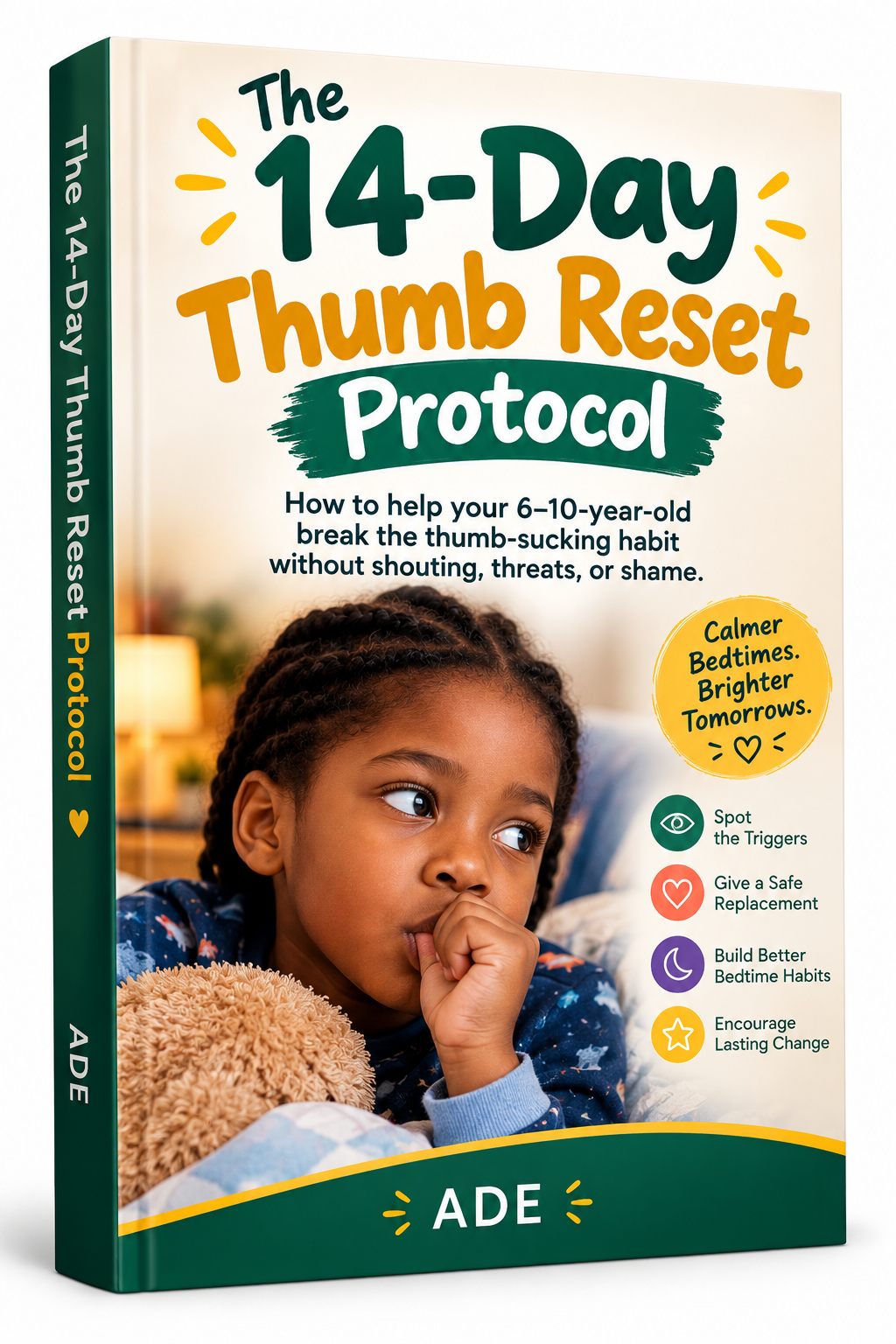
Everything Mama Ada taught me — documented, tested with other families, and written in plain, simple language so you can start tonight. No products to buy. No confrontation with your child. Just a calm, structured 14-day path built around one simple framework: Notice → Replace → Transition → Reinforce.
- The Notice Step — how to identify your child's exact comfort triggers before you start anything else (Pg. 4)
- The exact 14-day daily schedule — what to do each night, in order, with no guesswork (Pg. 6)
- The Replace Ritual — the simple bedtime substitute that gives the "comfort alarm" somewhere new to go (Pg. 9)
- The #1 mistake almost every parent makes in week one that quietly resets all progress (Pg. 12)
- The Daytime Trigger List — situations at school, in the car, and during homework that reactivate the habit, and what to do in each one (Pg. 14)
- Hidden comfort habits that often replace thumb-sucking if this stage is rushed — and how to avoid them (Pg. 17)
- The Monthly Maintenance Check — a short weekly routine to keep the habit from creeping back during stressful periods (exams, house moves, new siblings) (Pg. 19)
- The Extended Protocol for children who have sucked their thumb for 6+ years or who suck more intensely during sleep (Pg. 21)
You do not need to travel anywhere or order any special product. Everything you need is available in your home or your local market. Total cost of materials? Less than ₦1,000.
Compare That To What You Have Already Been Spending
The real cost — the one nobody puts a number on — is the years your child spends quietly believing something is wrong with them.
How Much Does This Guide Cost?
| Working with a child behaviour writer to structure the protocol | ₦48,000 |
| Testing the method with 11 families over 3 months | ₦35,000 |
| Editing, fact-checking, and plain-language rewriting | ₦18,000 |
| Design and formatting for easy home printing | ₦12,000 |
| Hosting, delivery system, and tech setup | ₦9,000 |
Putting this guide together cost me well over ₦120,000 in total.
A fair price for what's inside would honestly be ₦15,000. But I know times are hard, and I didn't build this to profit off other tired parents — I built it because I wish someone had handed it to me four years ago.
So if you take action today —
Once You Click That Button, Here Is What Happens
- You'll be taken to a secure payment page.
- Complete your payment by card, bank transfer, or USSD.
- Your guide is delivered straight to your WhatsApp and email within 60–90 seconds.
It is me, Ade. As long as your payment is confirmed, your access is 100% guaranteed.
What Happens In The First 7–14 Days
Real conversations. Real parents. Real results.
WAIT — I Have Something Special For You…
If you are one of the first 100 parents to get the guide today, you'll also receive these three bonuses — completely free.
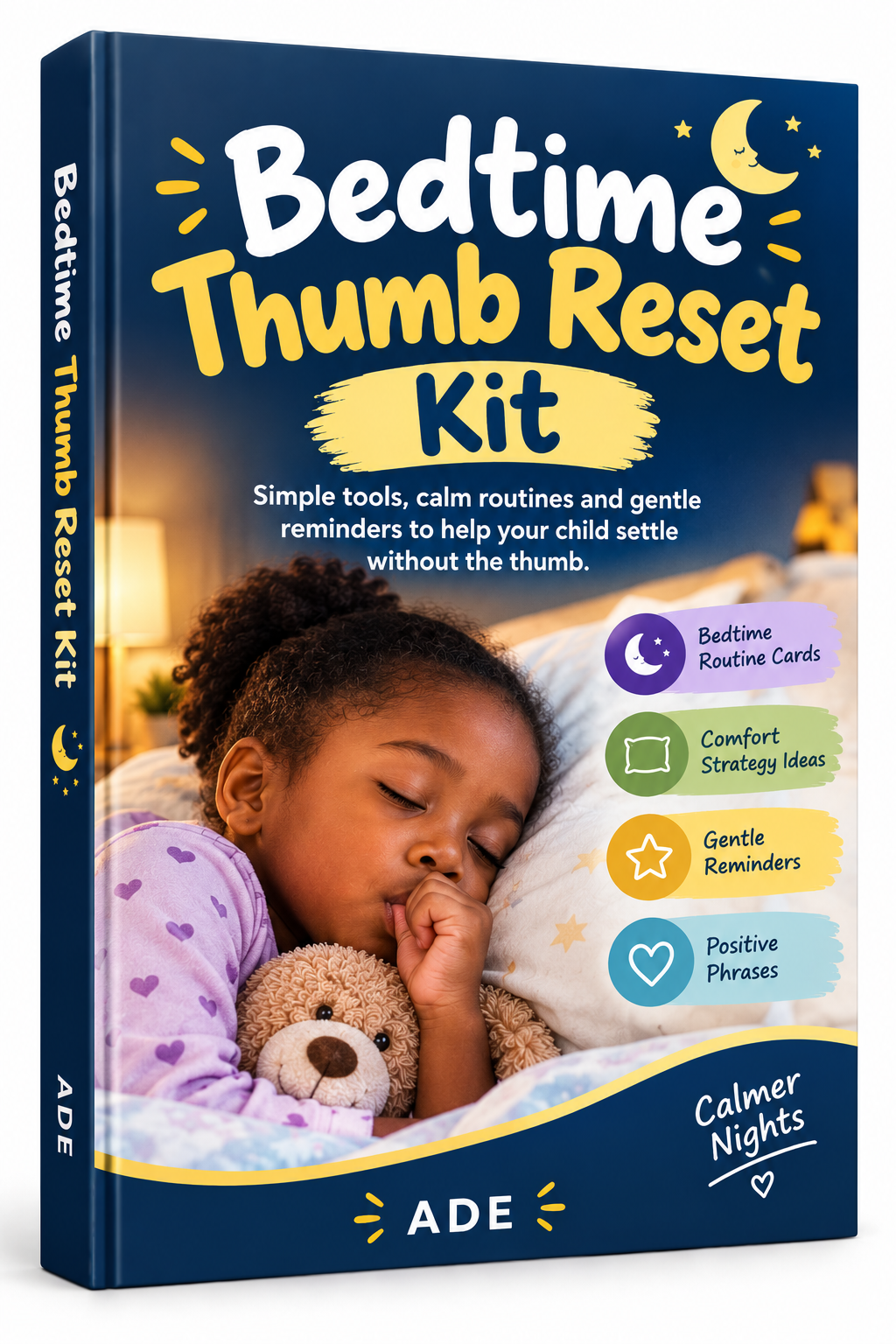
Bonus 1: Bedtime Thumb Reset Kit Value: ₦4,500 — FREE today
A printable set of calming bedtime scripts and a simple wind-down sequence designed to reduce the anxious, overtired moments that usually trigger the habit at night.
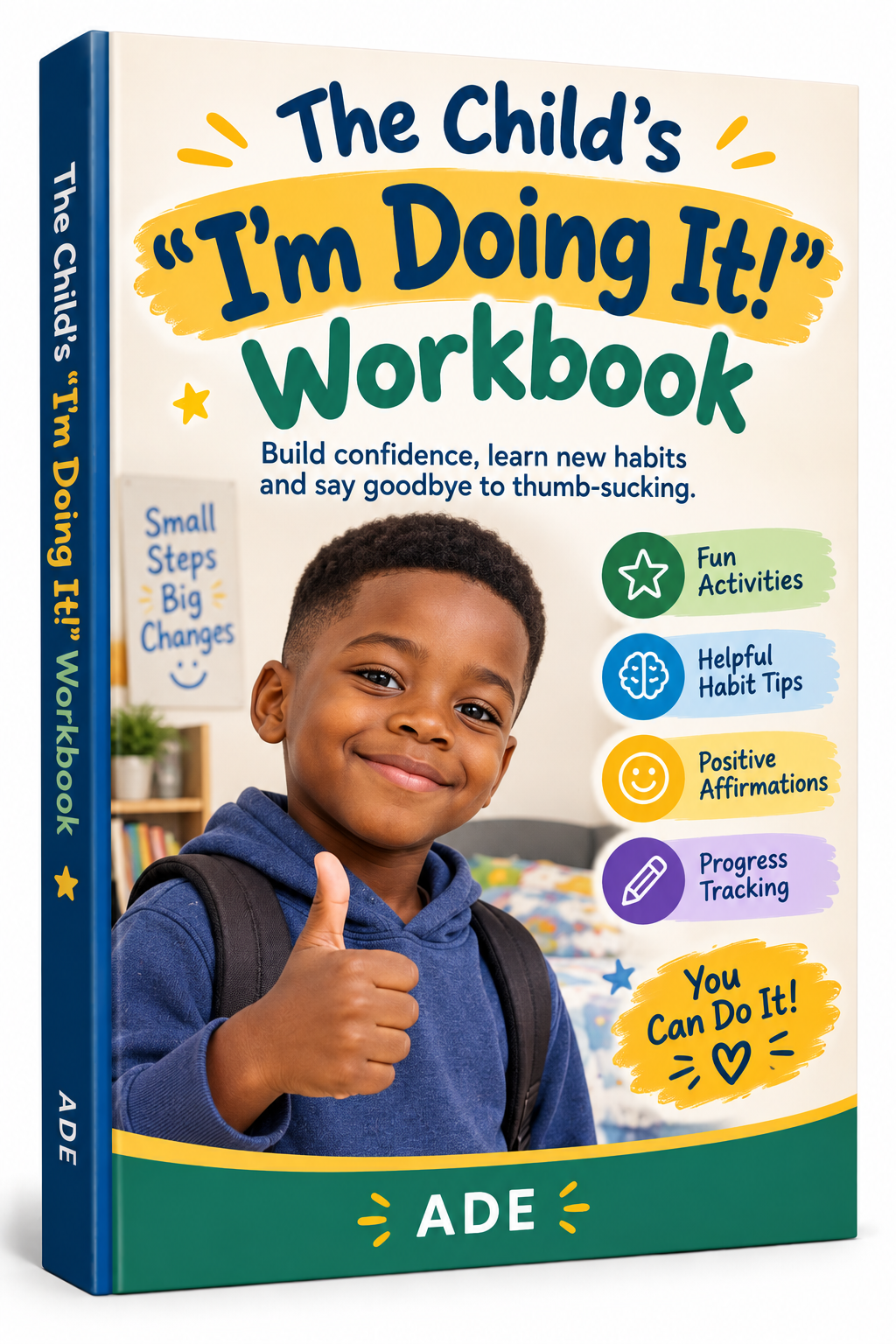
Bonus 2: Child's "I'm Doing It!" Workbook Value: ₦3,500 — FREE today
A gentle, colourful 14-day workbook your child fills in themselves — giving them ownership of their own progress without pressure, shame, or comparison.
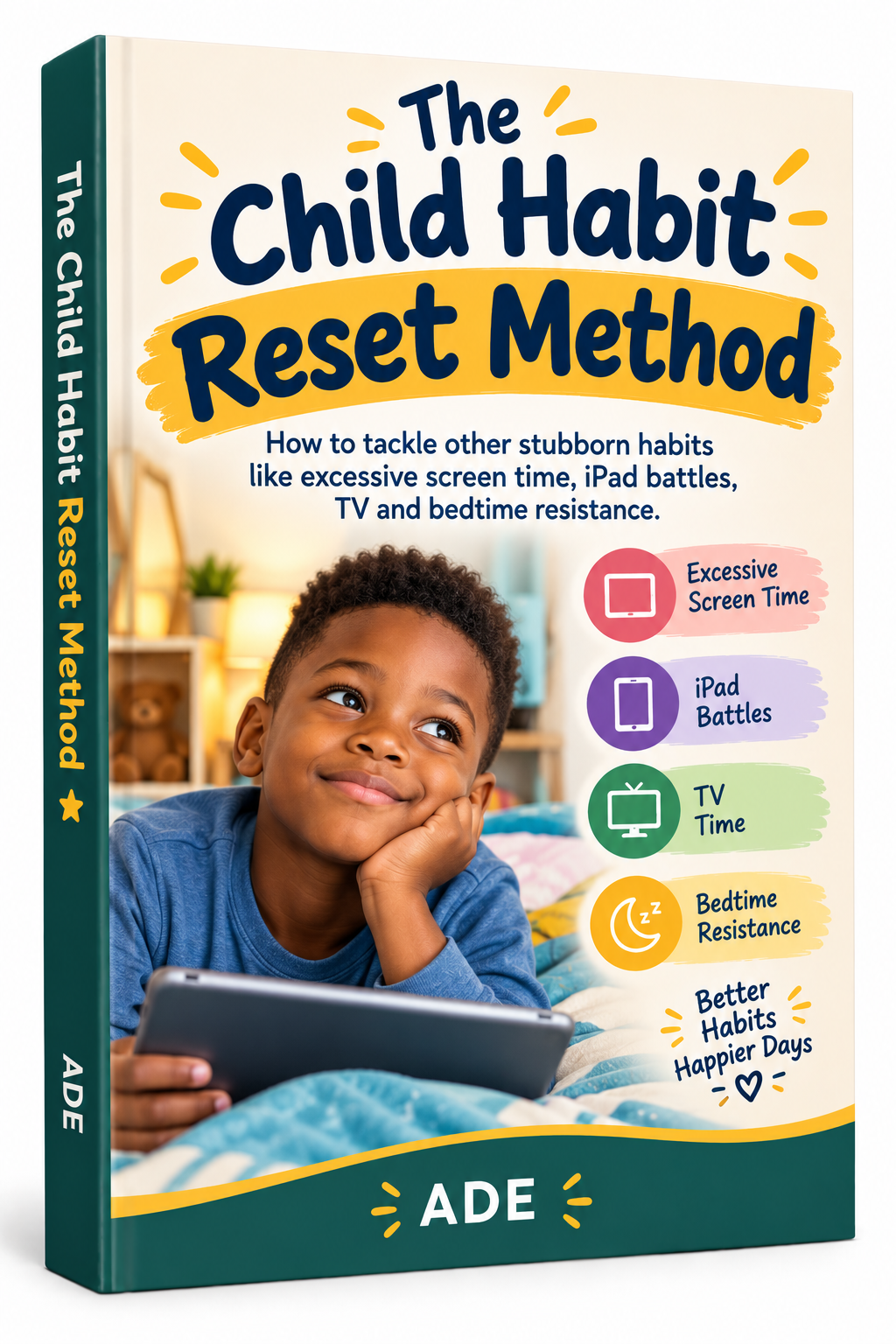
Bonus 3: The Child Habit Reset Method Value: ₦6,000 — FREE today
A companion guide applying the same Notice → Replace → Transition → Reinforce framework to other comfort habits — nail biting, blanket dependence, and bedtime clinginess.
Everything You Are Getting Today

- ✓ The 14-Day Thumb Reset Protocol ₦15,000
- ✓ Bedtime Thumb Reset Kit ₦4,500
- ✓ Child's "I'm Doing It!" Workbook ₦3,500
- ✓ The Child Habit Reset Method ₦6,000
Comments (18)
5 days ago
1 week ago
Leave a Comment
Right Now, You Have Two Choices
- Keep buying products that don't address the real cause
- Keep having the same tense conversations at bedtime
- Watch the habit follow your child further into school years
- Keep hoping it resolves on its own
- Keep quietly worrying every time someone comments on it
- Follow a clear, structured 14-day plan tonight
- Address the actual comfort trigger, not just the hand
- Watch your child gain confidence, not just stop a habit
- End the bedtime tension for good
- Finally stop carrying this alone
Follow the protocol exactly for 30 days. If you don't see a change in your child's habit, send me a message and I will refund you in full — no questions asked.
One Last Thing…
Picture yourself one month from today.
Will you finally stop dreading bedtime? Will you watch your child smile freely in photos again? Will you stop rehearsing excuses before family gatherings? Will you feel, for the first time in years, like you actually solved this instead of just managing it?
Now picture yourself one month from today if you close this page.
Everything stays exactly the same.
The difference between those two versions of you is a decision you make in the next sixty seconds.
Take The First Step TonightIf you have read this far and you are still hesitating —
It usually isn't about the ₦3,999. It's a quiet feeling that you don't deserve to make this easier on yourself. That somehow you should just keep pushing through the way you've been pushing through for years.
But if you cannot invest ₦3,999 in your child's confidence, how can you expect the world to invest kindness in them?
Stop hesitating. Choose your child.
Get The Protocol NowP.S. — Remember, this comes with a full 30-day money-back guarantee. There is no risk in trying this tonight.
P.P.S. — This discounted price is only available to the first 100 parents. Once that's reached, it goes back to ₦15,000.
P.P.P.S. — Every night you wait is another night your child falls asleep believing this is just who they are.
With love for your family's peace,
Ade
Frequently Asked Questions
How is the guide delivered?
Instantly to your WhatsApp and email within 60–90 seconds of your payment being confirmed. No waiting, no shipping.
Do I need to buy any special products?
No. Everything used in the 14-day protocol is already in your home or easily found at your local market. Total materials cost is under ₦1,000.
My child has been sucking their thumb for 6+ years — will this still work?
Yes. The guide includes an Extended Protocol specifically for longer-standing or more intense habits, with an adjusted timeline.
What if my partner is skeptical about this approach?
That's completely normal — I was skeptical too. The guide explains the reasoning behind each step so you can walk your partner through exactly why it works, not just what to do.
Is the 30-day guarantee real?
Yes. If you follow the protocol as written for 30 days and don't see a change, message me directly and you'll receive a full refund. No forms, no hassle.
Why is this different from everything else I've tried?
Most methods target the visible behaviour — the hand, the thumb itself. This protocol targets the underlying comfort response that causes the behaviour, which is why the results tend to hold rather than reverse once you stop.
3 days ago